
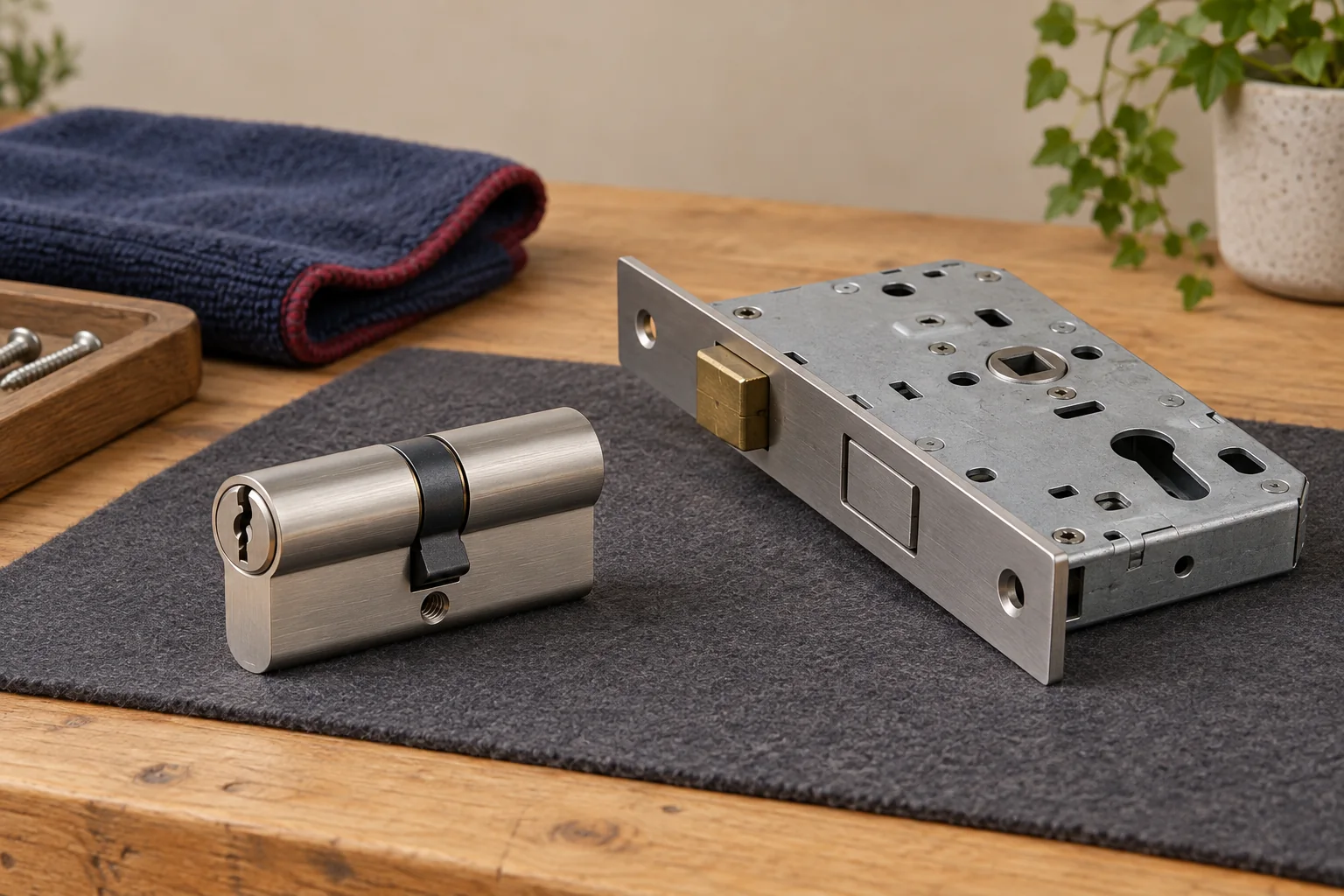
The cylinder receives the key and transfers its rotation to the lock mechanism. A freely spinning key, resistance or a loose barrel cannot identify a faulty part remotely. Here is how to prepare for diagnosis without making the problem worse.
Three situations to distinguish on the phone
- The key turns, but the door stays locked: say whether the handle still operates and whether the fault started suddenly. Do not keep turning the key to try to free the mechanism.
- The cylinder moves in the door: do not pull it or tighten a screw at random. Explain whether the entrance can still be closed and supervised.
- Part of the key is still inside: describe it as a broken key in the lock. This alone does not prove that the cylinder needs replacing.
The cylinder and lock case are separate parts
The cylinder is on the left of the illustration; its cam transfers the key’s rotation. On the right, the lock case contains the mechanism that moves the bolts. The parts are shown separately to explain their roles, not to suggest dismantling a blocked door.
If the key turns without moving the bolt, the connection or mechanism may be at fault. Ask whether the quote covers only the cylinder, the lock case or the complete assembly, and which check supports that choice. An exterior photograph cannot settle the diagnosis.
Tool marks, deformation or drill holes may indicate attempted forced entry. Avoid handling the parts, document the damage and have the security of the entrance checked.
Other causes to check
A loose fixing, damaged key or misaligned door can produce similar symptoms. Explain whether the fault occurs with the door open or closed, with one key or all keys. Stop testing if the key resists.
Before the visit
If the door is open, avoid closing it with a faulty mechanism. If you are locked out, describe the fault and door type: the opening method depends on the mechanism’s condition. A symptom alone does not establish that drilling or replacement is needed.
Choosing a compatible replacement
If the fault is limited to the cylinder and a compatible part is available, only that part may need replacement. The lock case, fixings and door alignment also need checking.
The ABUS measuring guide uses the centre of the fixing screw as the reference for both sides. Have these dimensions checked with the door open and the protective fitting in place. Do not dismantle a blocked door to obtain measurements. Total length alone does not specify the inside/outside split. The profile, cam and protrusion must also suit the lock and manufacturer requirements.
Choose after diagnosis. Security level, any emergency function and key-copy control must suit the door and its use. An ownership card governs duplicate orders under the system’s rules; it does not make a key physically impossible to copy.
Preparing your call
Provide your municipality, door type, visible markings on the mechanism and whether the entrance can still be secured. Parts availability and timing are checked for the exact reference. Do not share key codes or detailed photos of the key cuts.
Keeping shared access and checking the result
If the same key opens the entrance hall, garage or several doors, explain this before any part is ordered. The building manager may need to confirm the reference and ordering rights; a separate new cylinder does not automatically retain those entrances.
After cylinder replacement, ask the technician to check the keys and locking operation with you before leaving. Confirm the fitted reference, number of keys supplied and conditions for ordering duplicates.