
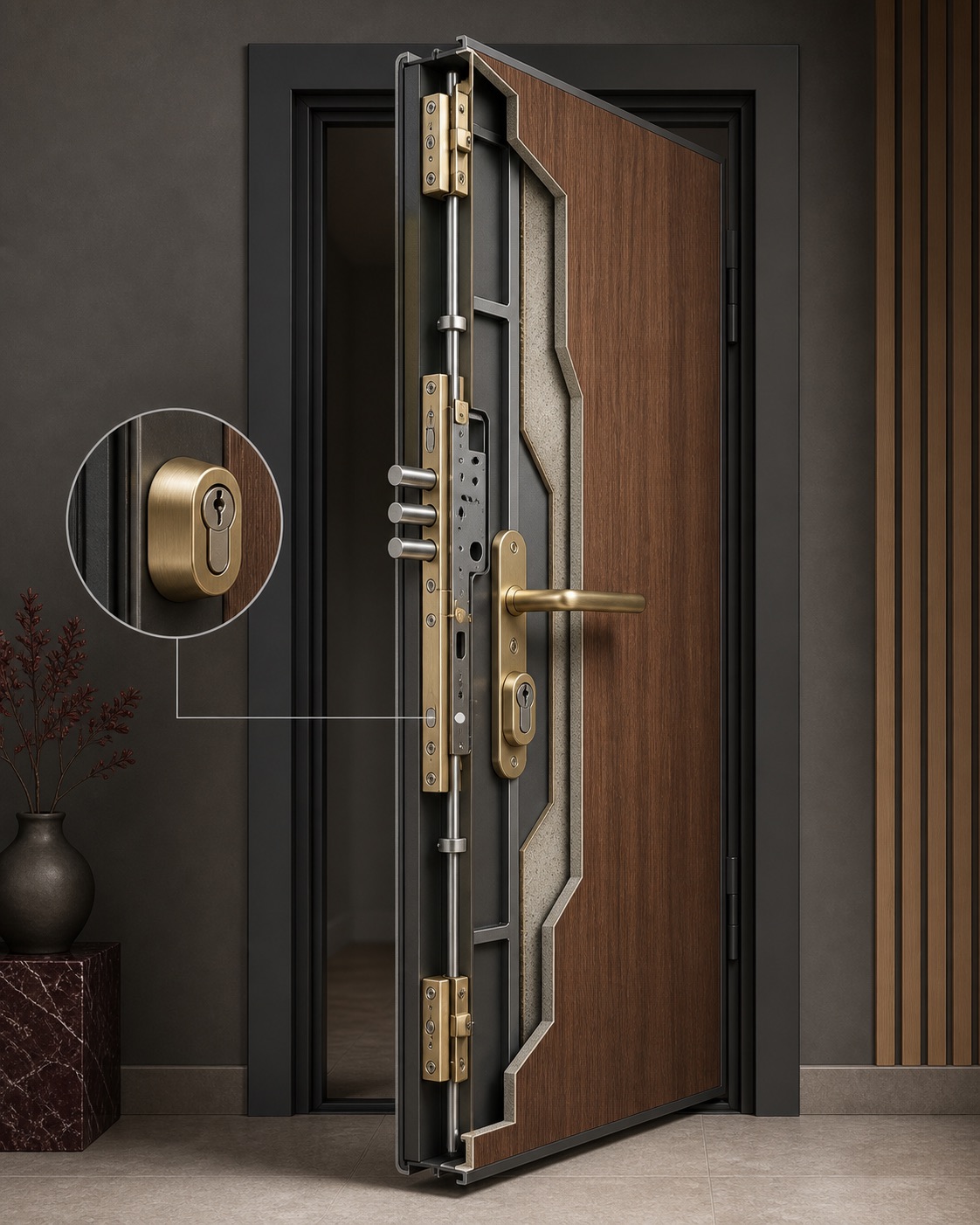
When people talk about securing their door, everyone thinks of the lock. But a front door is a chain: cylinder, lock case, strike plate, hinges, frame, panel - and a burglar looks for the weak link, not the strong one. Fitting a high-security cylinder to a door with liftable hinges is like putting a bank vault padlock on a garden gate. Here are the seven weak points we come across most often on our jobs, with the fix for each, from the simple move to full reinforcement.
1. The protruding cylinder
If your cylinder sticks out more than 2-3 millimetres on the outside, it offers a direct grip for cylinder snapping: a pair of pliers, a lever motion, and the cylinder snaps clean off, handing over the mechanism. It's one of the fastest break-in techniques on doors kitted out on the cheap.
The fix: a cylinder of the right length (measured on both sides from the central screw), ideally with anti-snap protection, or a security escutcheon that covers the cylinder. Modest cost, immediate gain.
2. The single-point lock
Check the certified reference, compatible components and fitting requirements. A brand or number of locking points alone does not establish the resistance of the complete door.
The fix: a multipoint lock (3, 5 or 7 points) that locks the door over its full height. It's the best protection-for-money upgrade for most homes.
3. The strike plate fixed with short screws
The original strike plate on many doors is screwed in with 15 or 20 mm screws - into the door frame only. A firm shoulder charge rips the whole thing out, whatever the quality of the lock.
The fix: a reinforced strike plate fixed with long screws that reach into the masonry or the structure, or a protective steel angle running the full height of the frame. It's invisible and devastatingly effective.
4. The liftable hinges
Everyone protects the lock side; experienced burglars look at the hinge side. On a door that opens outwards or whose hinges are accessible, lifting the door off its hinges gets you in without touching the lock.
The fix: anti-lift pins (fixed studs that hold the door in the frame even with the hinges removed) or security hinges. On an existing door, adding pins is a simple job.
5. Glazing within reach of the lock
A pane of glass in the door or a glazed side panel less than an arm's length from the handle: all it takes is breaking the glass and reaching through to open from the inside - especially if a key is left in the lock on the inside.
The fix: burglar-resistant laminated glazing, or replacing a thumbturn cylinder with a key-operated cylinder on both sides (keeping a key within reach on the inside for evacuation). And the simple habit of not leaving the key in the door.
6. The door panel itself
Some older or budget doors have thin lower panels - sometimes less than 10 mm of wood, or a simple honeycomb filling. The panel gives way to a kick, the lock stays intact, and the door is open all the same.
The fix: depending on the state of the door, an interior reinforcing plate, or door reinforcement that clads the existing door in a steel sheet - you keep the door, you change its resistance. If the door itself is at the end of its life, an armoured door block is justified.
7. The lack of a door chain and a viewer
The last weak point isn't mechanical, it's human: the door opened wide without knowing who rang. A share of intrusions force nothing at all - they take advantage of a door opened in good faith.
The fix: a solid door chain and a wide-angle viewer (or a video doorbell). A few dozen euros, fitted in one visit, and the habit of using them.
Where to start on a limited budget?
Check the certified reference, compatible components and fitting requirements. A brand or number of locking points alone does not establish the resistance of the complete door.
For a full picture of home protection - lighting, habits, windows - round things off with our guide on burglary prevention. And if you'd rather have a survey of your own door than a generic guide, our locksmiths run through these seven points on every job across Brussels and Brabant.