
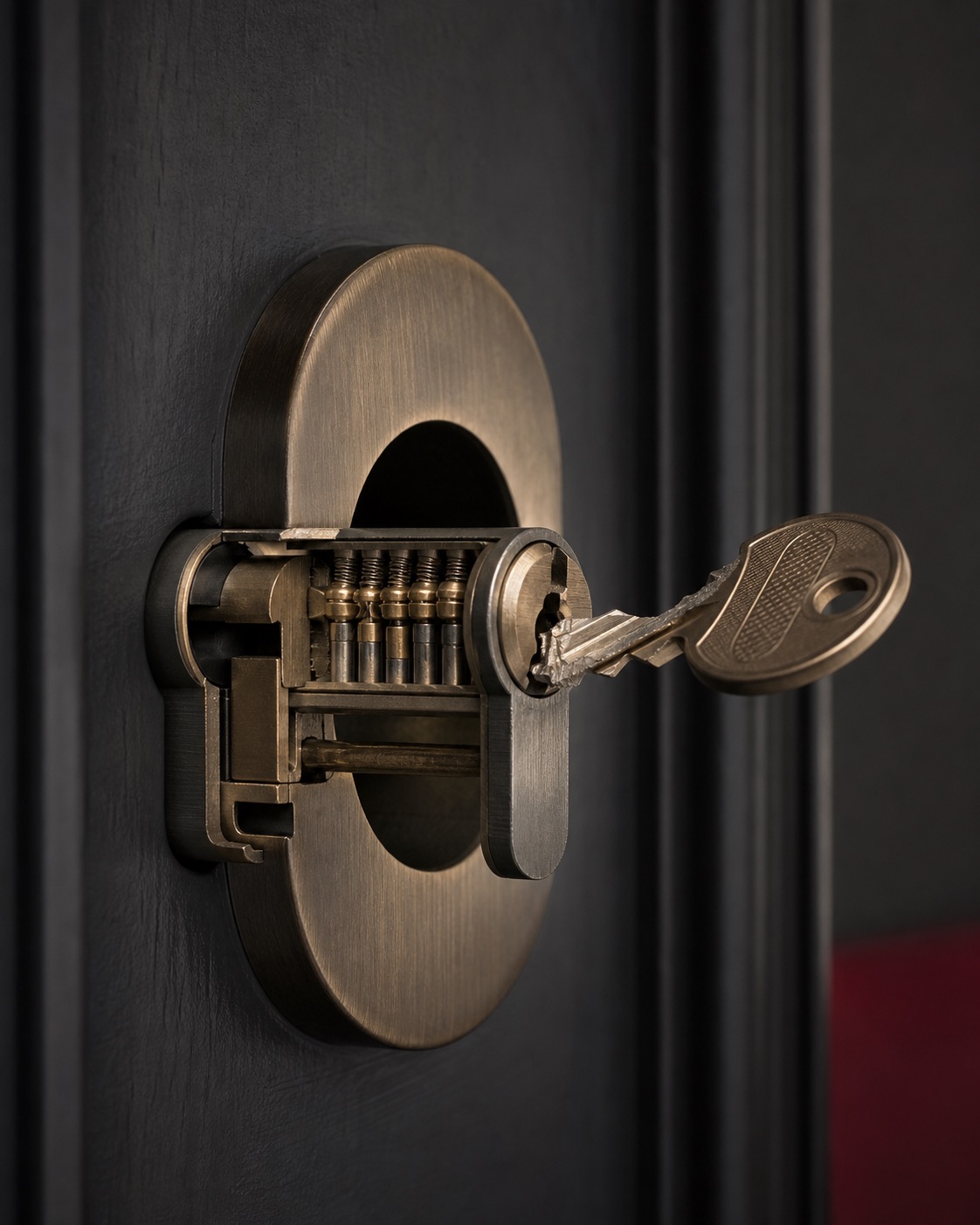
A key snapping clean off inside the cylinder is more common than you'd think - especially in cold weather in Brussels, when metal turns brittle, or with a worn key bent through force. The good news: in most cases the broken piece can be removed without replacing the lock, as long as you don't make things worse. Here's the step-by-step.
Stay calm and don't force it
The first reflex - pushing the other half of the key in or trying to force the door - is also the worst. You risk driving the piece deeper into the cylinder or bending the pins. Stop, take a breath, and assess: is part of the key still sticking out of the barrel?
Don't use glue
The superglue trick seen online is a false good idea: nine times out of ten you glue the fragment inside the cylinder and turn a simple extraction into a full replacement. Also avoid soaking the lock in thick oil - a little fine lubricant (penetrating type) can help, but in moderation.
If a piece sticks out: try a gentle extraction
If part of the key remains visible and grippable, you can try to remove it carefully with fine needle-nose pliers, pulling straight out, without twisting. If the piece is flush or fully pushed in, don't force it: that's the moment to stop before you damage the mechanism.
Don't turn the cylinder
As long as the piece is inside, avoid turning the cylinder: if the bolt ends up in the locked position with a fragment stuck, the job becomes considerably more complex. Leave the lock in the state it's in.
Call a locksmith for a clean extraction
A locksmith has dedicated tools, such as hook extractors, and will first assess whether the fragment can be removed without dismantling or drilling. If the cylinder was damaged by extraction attempts, a cylinder replacement may be enough without changing the whole lock.
Stop it from happening again
A key that breaks is often a key at the end of its life. If you were using a copy of a copy (increasingly imprecise), have a new key cut from an original, or consider a new cylinder if yours sticks. A cylinder that "catches" is a signal: better deal with it before a key snaps at the worst moment.
Broken key and a blocked door right now? Don't force anything more. Call 0495 205 400: we work 24/7 across Brussels and Brabant to extract the fragment and restore your lock, with non-destructive methods when the mechanism allows when possible.