
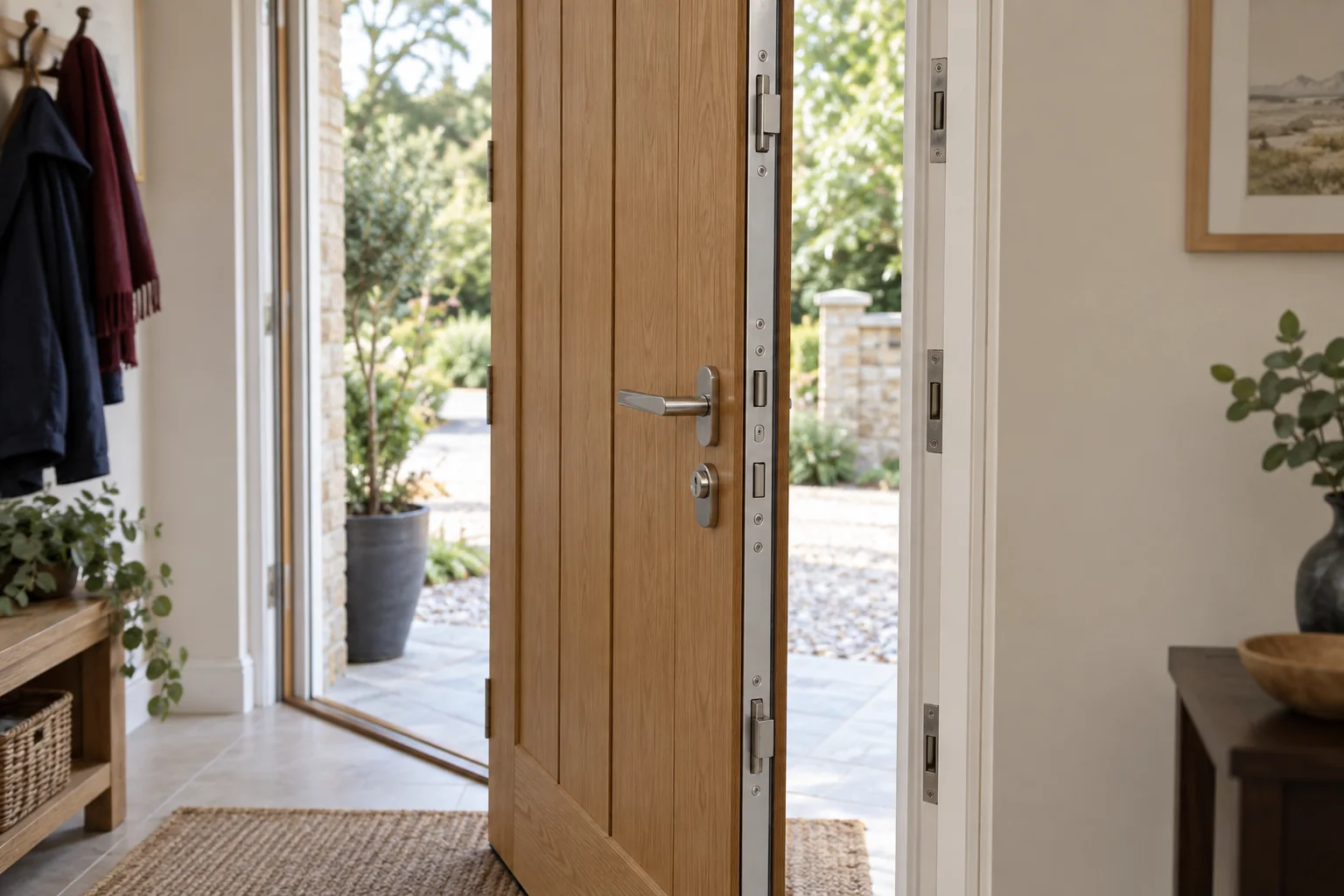
A multipoint lock operates several locking positions on a door. Depending on the mechanism, operation uses a key, handle or automatic locking. Follow the instructions for the installed model.
What do three, five or seven points mean?
These numbers describe locking positions, not a guaranteed resistance time. The lock design, keeps, fixings, cylinder and frame form a complete assembly. There is no universal mapping between point count and type of home.
Identify the parts on an already open door
The illustration shows a mortise multipoint lock: the metal strip visible along the door edge is the faceplate. The locking components are distributed along that height and engage with keeps fixed to the frame. The cylinder that receives the key is only one part of the assembly. Other multipoint locks can have a different form.
Key, handle or automatic locking?
Describe how the door worked before the fault: did you lift the handle, turn the key, or did the mechanism engage as the door closed? This helps identify its operation. Do not copy the procedure for a different model or trigger the mechanism by hand to test it.
If the door stays shut but will not lock, describe what stops it using the door will not lock guide. If only the key resists, start with the observations for a lock that will not turn.
Which photographs help identify the lock?
If the door is already open and can safely remain so, an overall view of its edge and a picture of visible markings help prepare a reference search. Do not remove the faceplate to photograph the inside. Keep key codes and key cuts out of the image; dimensions and compatibility will be confirmed on site.
The Winkhaus technical FAQ identifies backset and faceplate size among the details used for its locks. These are manufacturer identification points, not proof that a similar-looking part will fit.
Check compatibility
A mortice lock sits within the thickness of the door; a surface-mounted lock is fixed to its face. Replacement requires the reference, dimensions, opening direction and keep positions. Appearance alone does not establish compatibility.
If the mechanism is stiff
Do not force the key or handle. Explain whether the difficulty occurs with the door open, closed or both. Misalignment and an internal fault require different remedies. Have the mechanism examined before ordering parts.
Check the product and installation
For an assembly described as A2P, verify the certified reference and permitted components. CNPP describes certification of complete locks; adding a component from a known brand does not automatically certify the whole door. Keep instructions and references for the installed equipment.